When love overflows
There are moments when love overflows—not as gentle tenderness, but as anguish, worry, the fear of losing, an urgency to care. Moments when we want to help so much that our words become heavy, loaded, rushed. And without meaning to, what is born as care arrives as pressure. What is born as love can hurt.
Not because of bad intention.
But because of our humanity.
The scene: love, vulnerability, and words searching for form
This week I needed to write a message. All of me was in that message: my affection, my concern, my desire to help, my impulse to protect what I love.
And although my intention is usually to open conversations without hurting, without invading, without judging—careful of everyone’s dignity—when I am this deeply involved, my form often emerges as the opposite.
Even when what I want is to build bridges, what arrives does not always invite.
I believe this happens to most of us, at least once in our lives—especially when something matters deeply and touches our vulnerability.
We want to speak from love, without hurting, and at the same time we are overwhelmed. Presence turns into demand. Understanding into judgment. Observation into explanations that only cloud the field.
The paradox is that, while seeking something entirely different, we end up building the same thing—also from love.
When we are deeply moved, we tend to diagnose, judge, demand. As Michael Blumenstein used to say, we “step in and crush the other’s tomatoes.”
The intention is loving.
The form, for now, does not yet know how to hold that love without crushing it.
Co-regulation: adjusting without deauthorizing
Through Blumenstein Theory, I learned that when I feel vulnerable, that experience belongs to me—not to the other. And that if I want to build, I need to offer something that invites rather than overwhelms.
That is why I now review my messages several times before sending them. The first version almost never survives.
External eyes are a gift, as long as they are not weighted with:
“This is wrong.”
“This is not said like that.”
“This is too much.”
What is needed is someone who can see the good intention—and at the same time help adjust the form.
Not to “improve” the text.
But to care for the relationship.
To adjust without deauthorizing the emotion. To name the overflow without turning it into an error. To bring order to language without invalidating the anguish.
That is co-regulation.
That is relational ethics in action.
Form is also relationship
It is not only what we say that matters. It is how it arrives. The space it opens in the other. Whether it invites closeness or provokes defense.
In deep human processes, form can have more impact than intention.
And when that happens, we are not facing a personal failure, but a structural condition:
We are not designed to communicate; we are designed to build together.
And learning to build is a process—between two people, through experience, through trial and adjustment—while we live, love, fear, and lose.
Totally and brutally human
We can be clumsy when we love deeply. Imprecise when we are afraid. Overwhelmed when something truly matters.
That does not make us flawed.
It makes us human.
Blumenstein Theory, as a living relational ethic, does not ask us to stop feeling, but to learn how to care for one another when we do feel.
It does not seek communicational perfection, but dignity in the way we treat each other.
It does not require that we never make mistakes, but that we learn how to adjust without breaking the bond.
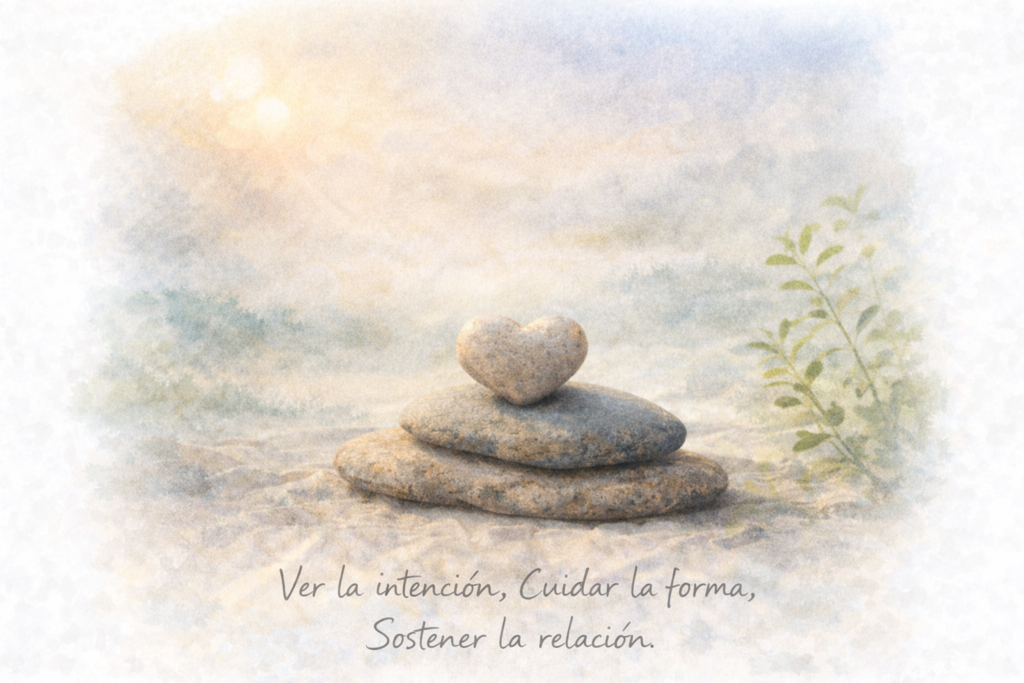
To see the intention.
To care for the form.
To sustain the relationship.
That is the art.
Closing
If your love has ever come out clumsy,
if your care sounded like pressure,
if your intention was good and the form had more impact than you wished—
You are not alone.
We are all, totally and brutally human.
And we keep learning, together, to speak from the heart—
caring for the form, and caring for the relationship.